Sunday, February 10, 2013

Ashtray


In reading Joan's post about Jim Groom's digital storytelling open course, in which daily assignments included taking Daily Shoots with themes, I decided I would begin such assignments.  The first suggests taking a photo of something circular, hence presenting a contrast with the rectilinear frame of photographs.  Looking to my left, I noticed my pineapple ashtray, originally my uncle Andy's and "given" to me/"taken" by me after he died in 2007. 

I think much more often when I converse with others.  I like to smoke when I converse and think.  The film Coffee and Cigarettes always fascinated me.  I don't really drink coffee, but smoking, talking, and thinking are all activities that I love to do.


Wednesday, February 6, 2013

Attempt at more explicit instructions


My group email this week on Universal Experience discussed the familiar and unfamiliar in tourism, and Ulmer pointed out that I need to “make [my] criteria for action even more explicit (what in UE resonates with avatar functionality?).” In this post, what I would like to connect is the avatar functionality with the familiarizing of the unknown/unfamiliar and/or the defamiliarizing of the known/familiar. 

First, we would do well to articulate/reiterate what the avatar’s functionality is.  From Avatar Emergency, Ulmer posits at several moments that the function of avatar is to advise me on my decision, to consult on all matters of prudence.  He continues: “The functionality of avatar concerns the ability of the persona and anecdote to materialize the attitude or stand (position, gesture) of thought as event” (17%).  In one class meeting, Ulmer remarked that the avatar function is to connect the individual back to the collective.  And finally, Ulmer noted today that the avatar function is “how we receive the reality of the world. . . . to teach people (how) to experience their collective individual behaviors. . . . to receive the capacity to be affected, to experience pleasure and pain.”

Now, as my email had articulated, if we are to design emblems that create “desires to evoke first an emotion, then the desire to share,” then where does the avatar function in this emblem creation?  And, if our emblem should evoke questions about what’s familiar and what’s unfamiliar/unknown, how do we could avatar advise us on that generate questions?  My attempt to explicitly lay out some criteria (and answer these questions):

1. Begin each day with an aesthetic attitude.  In every look, gaze, act, or gesture we have, these actions should have an aesthetic angle, both to our internal thoughts and feelings and to the outside world (objects, people, etc.).

2a. Visit a tourist site in Alachua County (some possibilities: Kanapaha Botanical Gardens, Harn Museum of Art, Lake Alice, Paynes Prairie Preserve State Park, et al.). Attempt to construct an epiphany.

2b. Wander around Alachua County with your mobile phone.  Attempt to construct an epiphany.

2c. Continue in our daily practices (going to seminar, class, grocery store, bar, etc.). Attempt to construct an epiphany.

3. Take pictures of the mundane in the tourist site, in the wandering, and in the daily practices when we experience pleasure or pain, regardless of whether or not the object is framed “perfectly” or your hand moves to create a blurry image (which is an instruction we get from Wenders’ Once).  That pleasurable or painful moment of engagement may be the generator for a constructed epiphany.

4. Load the pictures onto our blog, possibly trying to contrast them.  We may want to develop a very brief story of what was going on when those pictures were taken.

That’s all I have for now.  My brain is mush.  To be continued . . . 

Tuesday, February 5, 2013

Toreadorian memory


In 1999, I moved in with my dad, his girlfriend and my two "step-brothers."  I was 17 at the time, and one of my older step-brothers, Chris, was 27.  He introduced me to Salvador Dali.  He showed me The Discovery of America By Christopher Columbus, Apparition of Face and Fruit Dish on a Beach, The Persistence of Memory, Swans Reflecting Elephants, and The Hallucinogenic Toreador, which captivated me the most. I was affectively moved.


@


In 2004, I had returned to school after quitting my job as a mechanic at Goodyear.  I started at Scottsdale Community College with some basic classes: Introduction to Business, Accounting 101, and Microeconomics.  I didn’t know what I wanted to do for a major or even a career, but I decided what every undecided undergraduate might do at a community college: pursue a business degree. Plus, that pleased my dad.  For the past ten years, my dad had told me to choose a trade ― carpentry, automotive, masonry, electrical ― and he facilitated many moments for me to engage with these trades. My family is working-class, and in more ways than simply occupation. But working-class work was readily available, through my dad’s friends or my relatives or the weekend projects my dad always had lined up.  In the summer of 1996, my dad planned to carpet and drywall the basement.  He wanted to have an area for me and my brother to play, as well as a place where he could set up a TV for when he felt the need to escape from my mom.  Thus, at fourteen years old, I assisted him in finishing the basement.  My brother was eleven years old, and for some reason was not included in the manual labor (although I remember having to help my dad at that age).  So, it was me and my dad. 

After we drywalled, carpeted, and trimmed the basement, in July 1996 Naperville and Aurora got 17 inches of rain.  The streets and backyards were three to four feet deep and basements flooded.  Our basement had eight feet of water.  I remember people canoeing through backyards, riding bikes in the street, and kids using sleds to float around.  I borrowed a friend’s sled and floated around watching the canoes.  My imagination drifted along with the canoes.  I thought about what I would do if I could just paddle along in a canoe. Yes, adventure to navigate the waters, but I was more interested in the time I would have to think.  Even at fourteen, I would yearn to simply think, primarily about purposes and what would be considered abstract ideas.  I can’t recall what exactly were my questions or inquires, but I remember thinking that I couldn’t talk about such things with my dad. My questions and inquires would have been conceived as too “ideal” or “impractical” by my dad. As I would come to understand years later, he wasn’t interested in philosophy, literature, or the arts. 

After pumping the eight feet of water out of our basement, my dad and I pulled the drywall and carpet and spent the next month redoing the basement. Redrywalling, recarpeting, retrimming.

After I graduated high school, I moved to Phoenix, Arizona and attended Universal Technical Institute for an associates in Automotive Technology.  In other words, an eleven-month program that would enable me to get a decent job as a mechanic.  After graduating, I got a job at Goodyear Tires, where I worked fifty-five hours a week on the clock for three years.  Four months of the year was engulfed with 110-115 temperatures. The shop didn’t have air-conditioners, only swamp coolers, so every summer I felt like my brain was frying for ten hours a day.

Eventually, I said I was done working on cars.  I don’t remember the incident or moment that made me quit Goodyear and go back to school, but I know it had something to do with not being able to have stimulating conversations with my co-workers.  Our shop was busy, so there was really never any downtime. Plus, my co-workers weren’t intellectuals (which I didn’t identify at the time, but years later).  I tried several times to talk about various philosophical topics (or really anything other than cars), but I always hit a brick wall.

After that first semester at SCC, I felt a need to explore other subjects. Introduction to Business, Accounting 101, and Microeconomics weren’t cutting it for me. I wanted the intellectual conversations I had tried to have at Goodyear.  The next semester I enrolled in Introduction to Philosophy, World Religions, Humanities Survey, and Ethics in Business.

It was in my Humanities Survey course that I was introduced to Descartes by my teacher Sandra Desjardins.  She lent me her copies of Meditations on First Philosophy and Discourse on Method.  I melted.  I was fascinated with Descartes approach to thinking. Considered the “father of modern philosophy,” he would often sit in front of his fireplace and think. Arguably, he was one of the first to question what is real.  In another post, I will explore in-depth Descartes argument, but what I want to underscore is that I was taken by Descartes.  I was affectively moved, epiphany-induced, avatar-activated.

I also decided I wasn’t going to major in Business. When I told my dad that, he, once again, asked what my plan was.  I said I didn’t know. He said I should go back to working on cars.  I said I wasn’t interested in such work.  So what are you going to major in?  Has to be something practical.  I mean, what is it you want to do?  I said I wanted to sit on a stool in an orange grove and think. You’re ridiculous. I want to simply think.  And eat oranges. Oranges were/are tasty for me, and nearly every morning I drank, and still do, a glass of orange juice, as well as at night.  Descartes got me to think about thinking.  The layers of thinking intrigued me.  Years later, my grandma would tell me “Phil, life is like an onion.  You just gotta peel back the layers one at a time.”  What my grandma left out of that advice is that “sometimes you weep.” Nevertheless, I consider thinking is onion-like: peeling back layers of thoughts. I would say also 75% of my meals have onions included, either caramelized or raw.

An orange grove.  In 2011, I moved to Gainesville, Florida to attend the University of Florida.  Florida, the home of oranges.  I don’t live in an orange grove and maybe a stool awaits in some grove I haven’t yet literally visited.  Had I wanted to be a philosopher?  Why did I go into an English program?  Retrospectively, I know I switched my track to Rhetoric and Composition from American Studies because the former connects tightly with philosophical thought and critical theory.  But I’m not as well-read as most of my peers in philosophy.  And yet, most of my friends back home used to call, and still call me Phil-osopher. But I’m no philosopher.  I just like to think.  Yet the more I think, the more I realize I’m not that great of a thinker. 

philo- "loving"   sophia- "knowledge, wisdom" 

In the last chapter in Avatar Emergency, Ulmer remarks, “That was my decision, to be a scholar.” Ulmer became what he was through his decision.  He is owning up to his decision, whether or not that decision rendered him to become what he had hoped. Have I owned up to my decisions?  To attend graduate school with not being as well-read as others?  Do I actually belong in graduate school?  I thought I had figured out my community, my family: academics.  Since I have cast out and alienated myself from my blood family, I look to developing a new family (academics). But my thinking isn't up to par with others in the program....so what the hell am I doing here?

More importantly for the seminar, what does all this have to do with my/our project?  What the hell did I just ramble on about?  Why does it matter and (how) does it connect to the Superfund site?  What exactly is my allegory of prudence?  The decision to go into teaching and academia?  To pursue a degree in the Humanities (against my dad’s wishes)?  What does Descartes’ Meditations on First Philosophy and Discourse on Method have to do with all of this? Descartes articulated firmly a mind and body binary (and most of modern philosophy for the next three hundred years or so perpetuated such a paradigm).  Maybe I need to run a CATTt on my individual experience. Contrast: Mind/body binary. Analogy: ???? Theory: Ulmer and embodiment.  Target: Become what you are. tale: traveling thoughts and affects.

Monday, February 4, 2013

Inspired Once

My friend Jake wrote on his blog
a post Once.
He also mentioned in an email
that when he travels,
he usually takes pictures of
bars,
beer glasses,
streets,
and doors.
I thought about similar attractions
I have when traveling,
like when I lived in Peru . . .


 and laid in my hostel room in the Sacred Valley
and took a picture of the ceiling light, or
 when I walked around my Arequipa neighborhood
and found a pile of rubble, or


when Dawn and I met in Pisco this stranger named Rodolfo
who had just finished rebuilding his house
after an earthquake hit the town.
Rodolfo chatted with us for over an hour
and showed us pictures of his daughters
and gave me pictures of buildings destroyed
right after the earthquake, or


when Dawn, Alan, Patricia, and I
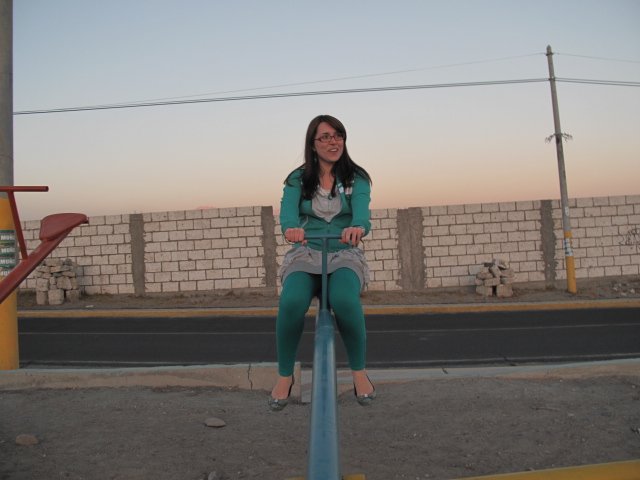
found a small playground with a mini merry-go-round
and a see saw

and swings.
And I remember our stumblings
upon this playground were shortly after
I decided I was going to leave Peru
and apply to graduate school.


Traveling people


When my friend and I went to Blue Gill for breakfast two Sundays ago, we were discussing tourism and travelling and I came to realize that stories are essential for a meaningful experience when “on the road.”  Not the stories we tell after the experience, but the personal stories that make the sight or object meaningful and interesting.  I mentioned how when I lived in Cyprus for a summer (back in 2007), I would walk around the capital city Nicosia and not find much enjoyment from the buildings and the streets.  Of course, I thought about the architecture and I wasn’t totally bored.  But it was when I chatted with locals and heard their stories and about their experiences with particular establishments or landmarks that I felt a connection.  When people travel, I think they want to feel a connection.  To others.  To places. To objects.  Or at least that’s how I travel. And I don’t necessarily want the idea of calling myself a “cultured” or “worldly” person.  In Universal Experience, Carol Becker mentions how tourism and travel evokes the sense of feeling cultured or worldly.  To say “I’ve been here” or “I’ve done this.”  I’m interested in what stories people have, as well as how those stories have constructed their mindset and paradigms.  Part of this connects to why I teach.  I’m interested in how students think and why they think the way they think.  Information is meaningless, or at least uninspiring for me. Knowledge, often created from the stories we tell and the experiences we have, is much more interesting.

And the connection I yearn for when I travel, whether from my apartment to campus or from the states to a different country (or another city or state), is typically found in the traveling (and not the destination).  I enjoyed in UE the section on pilgrimages.  Yes, the process, the traveling is where the most value resides.  The destination holds meaning, but the journey to the destination is where things happen.  I love road trips, both solo and partnered. No destination or destination, road trips give me time and space to think.  When partnered, I can think and converse, typically on a wide range of ideas (of course, depending on who is traveling with me).

After reading Wim Wenders’ Once, I noticed how nearly all his travel stories and photos involved people.  Rarely was a story or photo simply about a landscape of nature. Part of our project, or at least what I want to develop, is an emblem that connects to people and the affective text.  If I work off my Decartes experience, my teacher at the time ― Dr. Sandra Desjardins  ― would be the person that connected me to that text. But back in 2004, I didn’t have a camera nor a phone, so I don’t have any pictures of her or of something that could explicitly connect an image to her, the text and the moment.  I did google her and found this video.


Last Saturday,
I was sitting on the back porch 
with my friend (who I was at Blue Gill with). 
We talked for awhile, primarily about death
and dying and suicide and success
and living in the world amongst others.
I felt relaxed as I listened to her
 and explained my approach to dying.
 I told her I’m not really afraid of dying. 
I mentioned that I don’t fear dying 
(or at least that’s what I tell myself.  
Maybe in a dire situation, I would fight to survive). 
I said if the apocalypse were to happen right now,
I would just sit and watch. 
I wouldn’t try to play hero survivor,
like so many TV shows and movies suggest
(and it seems like a lot of people
 make those fantasies for themselves). 

Super Gangnam Orleans


2013 Super Bowl weekend in New Orleans. I traveled to New Orleans in 2008 and 2009 to volunteer in the 9th Ward, a neighborhood opposite the French Quarter across the river.  Where the levee “broke” (and many consider the levee was blown up by explosives in order to not flood French Quarter/downtown NO) flooded this neighborhood.  


The “Gangnam Style” video has the most video hits (reaching over 1.1 billion a couple of weeks ago).  The song worked its way into a “flash mob” incident in NO a couple of days before the super bowl.

I didn’t watch the super bowl yesterday. I don’t particularly like PSY’s Gangnam Style song (although the song is catchy). And yet I found myself watching this video a couple of times. 


Zizek explores the Gangnam Style phenomenon. 


“pure ideological phenomenon” (Zizek)


And then I wondered what Miss Bessie, the woman whose home I worked on in the visits in 2008 and 2009, and her disabled son Jessie were up to.  I wondered how she was doing.   


I’m not sure what exactly I’m trying to say with this post.  I see the melding of entertainment (super bowl and Gangnam style) and a juxtapostion of my experiences/images.